
On loyalty to the spiritual father, as well as the correct attitude towards the spiritual guides of the Church
~+~
The Roman centurion is an extraordinary example of love for the spiritual father (or spiritual guide), especially how we should protect him from unnecessary work, that is, how to give him time to rest and regain his strength – so that he can help others who are suffering.
We recognise the true faith and love of the centurion, not only from his love for the God-Man Jesus Christ, but also from the love he shows for his neighbour – he does not plead for himself, but for his servant, as well as from his love for all others who suffer and are in need of Christ, for whom he shows compassion and to whom he leaves time and opportunity to approach Him.
His behaviour is completely opposite to the ill-attachment to the spiritual father (or spiritual guide) recklessly using up his time, and, the jealous guarding of him – keeping Him only for himself; but also to the point of hostility towards anyone who seems to us that they are threatening our position with him, as well as towards anyone who we think threatens his position as a spiritual father (or spiritual guide) – in general.
Do not forget that the only spiritual father is the Bishop of the local Church; all others who are appointed by him (the presbyters or the auxiliary Bishop), to help people in their spiritual development, are only spiritual guides who are his extended hand and, everything they do – they do it in his name, and naturally – in the name of Christ, as the Bishop does everything in the name of Christ. All true spiritual guides direct their children, not to themselves, but to their Bishop and to Christ, and every true Bishop directs them, not to himself, but to Christ – this is how the unity of the Church is preserved. Naturally, spiritual fathers, i.e. Bishops, should also have love among themselves – this is how we know that they are Christ’s disciples.
Also, for example, it is customary in our local Church (Diocese) for those who show interest in monastic life to be directed by their spiritual guide to the spiritual father, i.e. to me. The same applies if a spiritual child turns out to be a more specific case – for which greater spiritual experience is required, i.e. knowledge, or, alternatively, it is enough for him to just want to, and to pass under my spiritual guidance – if I assess that this is necessary. Therefore, it would be a great ignorance of the order in the Church, as well as an ill state of mind and attachment to the spiritual guide, if someone, in such a case – for example, would even think, let alone declare, that the one who passed to me – had betrayed or was unfaithful towards his spiritual guide. Such a thought or claim would be precisely a betrayal of Christ Himself, in Whose place I sit and Whose icon I represent as Bishop.
Children, such behaviour would not be harmful to me, but rather to you, as well as to the church order. I will be leaving in due course and it is my duty to leave a correct Holy Tradition to the one who comes after me; after which I will be in the administrative position of a spiritual guide, and not a spiritual father. That is true love for the one who comes after me, both on my part and yours, because what we sow now, we will reap later. Any disease that is not prevented or treated will spread; especially spiritual diseases. Preserving the Holy Tradition is also the task of spiritual guides, if they care about the spiritual development of their spiritual children and their progress in general. And the font of the described Holy Tradition, of the relationships established in this way, is the Holy Liturgy of the Church Itself – which is led and presided over by the Bishop; everything springs from the Holy Liturgy. Whoever excludes himself from the Bishop, who presides over the Liturgy, in the place and in the image of Christ – as His icon, excludes himself from everything!
In addition, it is normal that the Bishop cannot establish a personal relationship with all his spiritual children as the spiritual guide can with those he directly guides in spiritual manners, nor would such an ambition be healthy and possible; and it is normal that everyone is free to choose the spiritual guide to whom he will confess or, alternatively, to change his spiritual guide, but all this should happen through a correct relationship towards both the spiritual guide and the spiritual father – within the framework of the local Church. Outside of prescribed procedure, there is no spiritual development, but rather a mental illness.
The spiritual guide, in fact, has the role of the centurion mentioned in the Gospel – he should relieve some of the load of the Bishop, his spiritual father, and this, at the same time, will also mean a faster healing for the one he is praying for, i.e. for the one he guides spiritually. Such a role should also be played by those who hold positions of the state, but about that – another time.
The pious attitude towards the spiritual father (or the spiritual guide), at the beginning – until the opening of the heart for mind-and-heart prayer, implies attachment to his word, and not to him specifically; because a correct personal relationship is achieved only at the second stage of spiritual development – enlightenment of the mind.
The word of the spiritual father should be the word of Christ – the word that leads to Christ in our heart, and the word of the spiritual guide should be the word of the spiritual father and the word of Christ. On the other hand, where there is no word of Christ, it usually comes to, putting it mildly – mental and corporal attachment to the “spiritual guide”. The difference can be compared to the difference between good health and illness. I have reminded you several times so far about this topic, because this phenomenon is rare among us – but it still exists on some unconscious level, but today I am using the Gospel reading of the day, to explain it to you most clearly.
We have seen what the word with power means, i.e. the word of Christ. The God-Man Christ only spoke a word and the centurion’s servant was healed at the same hour. The word of God, i.e. the word with power, is fulfilled: we see this in the creation of the world and man – from nothing that existed before; we see this in the many healings of the sick; and in the multiplying of the loaves and fishes; and in the management of natural elements; and in the casting out of demons; and in the turning of water into wine; and in the resurrection of the dead; etc…
So too the Liturgical (Eucharistic) word is fulfilled, and it is a word with power; source of the word with power, which constantly renews and transfigures the world, which, in turn, often falls away from Christ; it is accomplished because Christ, through the specific celebrant (priest, minister) of the Liturgy, is the One Who offers, and Who offers Himself, Who receives and is Himself given, i.e. The One who serves. We are only His fellow concelebrants.
The word of God, the Liturgical word, the word with power, accordingly, is already possessed by the one who enlightens his mind – through the gift of mind-and-heart prayer; the one whose mind invisibly worships before the altar of his heart. Such a one transmits to you the Holy Tradition, and this will continue if there is someone to receive it. We ourselves, determine the “end” of the Holy Tradition; not some satanic forces.
Therefore, you do not have exactly the blessing to assist and I would not recommend that you receive Holy Communion, if you deliberately do not read it and treat the word of your Bishop carelessly – it is the same as not wanting to participate in the Liturgy; because that too is part of the one Holy Liturgy that we conduct. You have no excuse if you do not take at least five minutes – once or, two to three times, a week, to read what I have to say to you. Respect the word of your Bishop, if you want to be healed.
In one word: Christ is our everything, we are nothing and let us not get carried away too much!
Metropolitan of Strumica. Nahum
28 / 06 / 2026
++++++
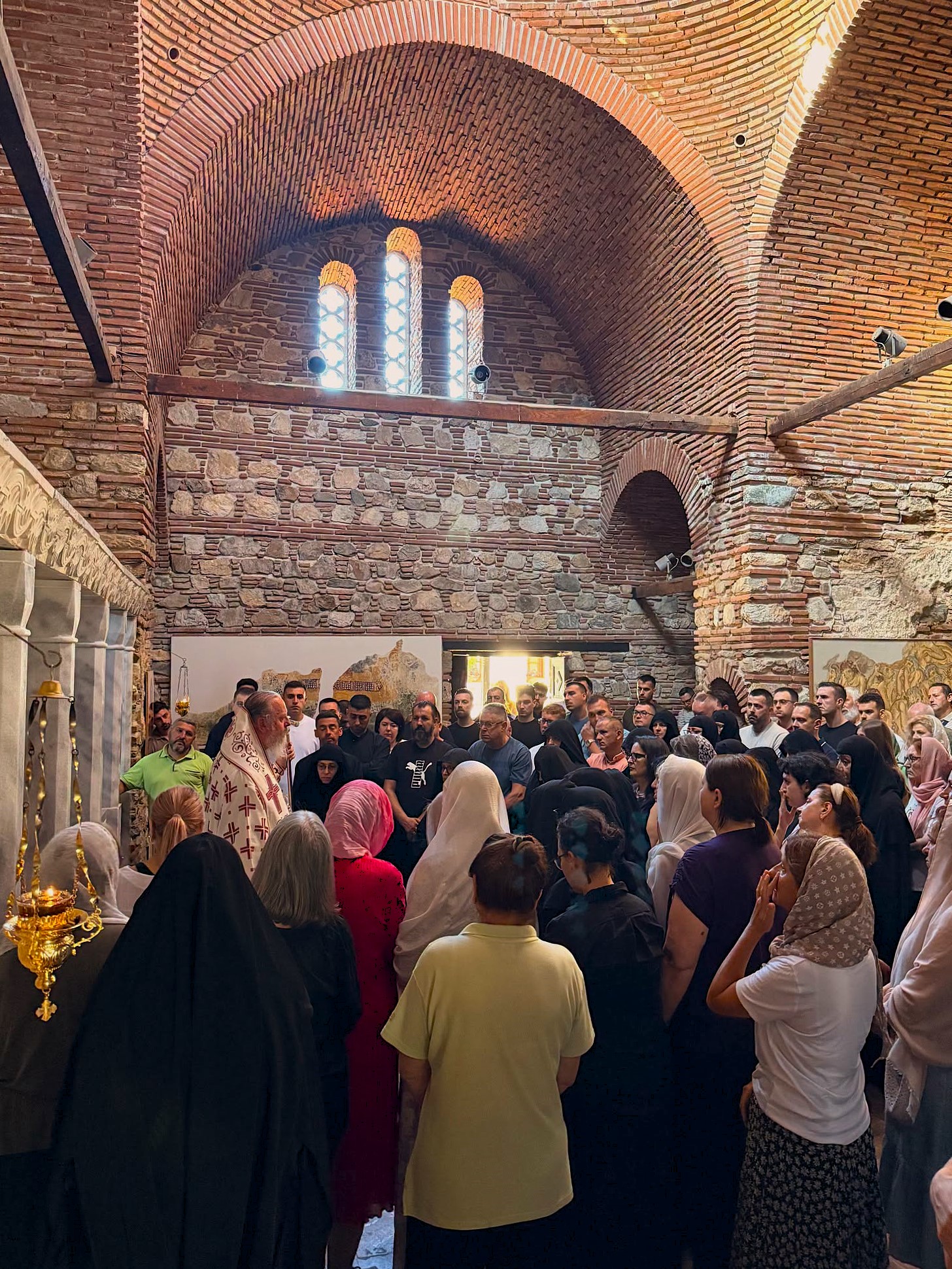
Divine Liturgy in the Monastery of Saint Leontius of Strumica and of Jerusalem, and the Protection of the Most Holy Theotokos in Vodocha.
