
Prostrations – Father Gabriel (Galev)
~+~
God is spirit, and we should worship Him in spirit and truth. This worship as an expression of our inner, spiritual reverence as psychosomatic beings befits us, and is inseparable from our special respect we owe to God, both with our spirit and our body – through designated actions. One of these actions is prostration or bowing. The deep one (low bow) – to the ground, and the shallow one – to the waist.
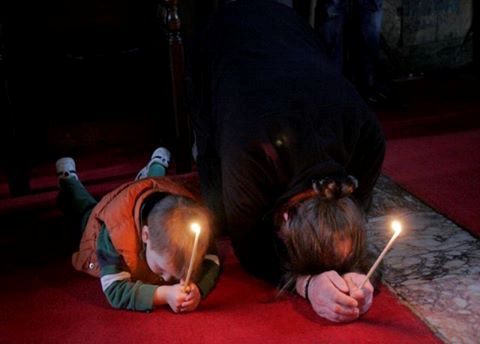
Prostration signifies repentance – a change of mind, a change that occurs in our mind. When we perform prostration, then, we offer a penitential motion before God. The Holy Fathers say, “One prostration, one tear.”
When we touch our forehead to the ground we humble ourselves and remind ourselves that we are sinners created from the earth and to the earth we shall return. When we stand up, we witness the Resurrection – both our own and that of Christ.
While performing prostration, the Jesus Prayer is said: “Lord Jesus Christ, have mercy on me, a sinner.” Saying the prayer, when we stand upright we confess the Lord Jesus Christ as the Son of God, and when we bow low, touching our forehead to the ground, we confess our sinfulness.
We make deep prostrations by first resting our hands on the ground, and then touching the ground with our knees and then our forehead. There are various “rules” regarding how prostrations should be executed, however, I would say, all of these are largely insignificant and, at times, incorrect. Prostrations are primarily made in the heart, in contrition, a repentant spirit, and humbly.
Deep prostrations are not performed on; Saturdays and Sundays, the days when we do not fast, during the first week after Easter and Pentecost, and from Christmas to Epiphany, as well as on all the feasts of the Lord and the Theotokos. On these days, only shallow prostrations – bending to the waist, are made.
Father Gabriel Galev
Abbot of the Monastery “St. Clement of Ohrid”,
Kinglake, Melbourne, Australia
