
HAGIOGRAPHY OF OUR VENERABLE MOTHER PARASKEVA – PETKA
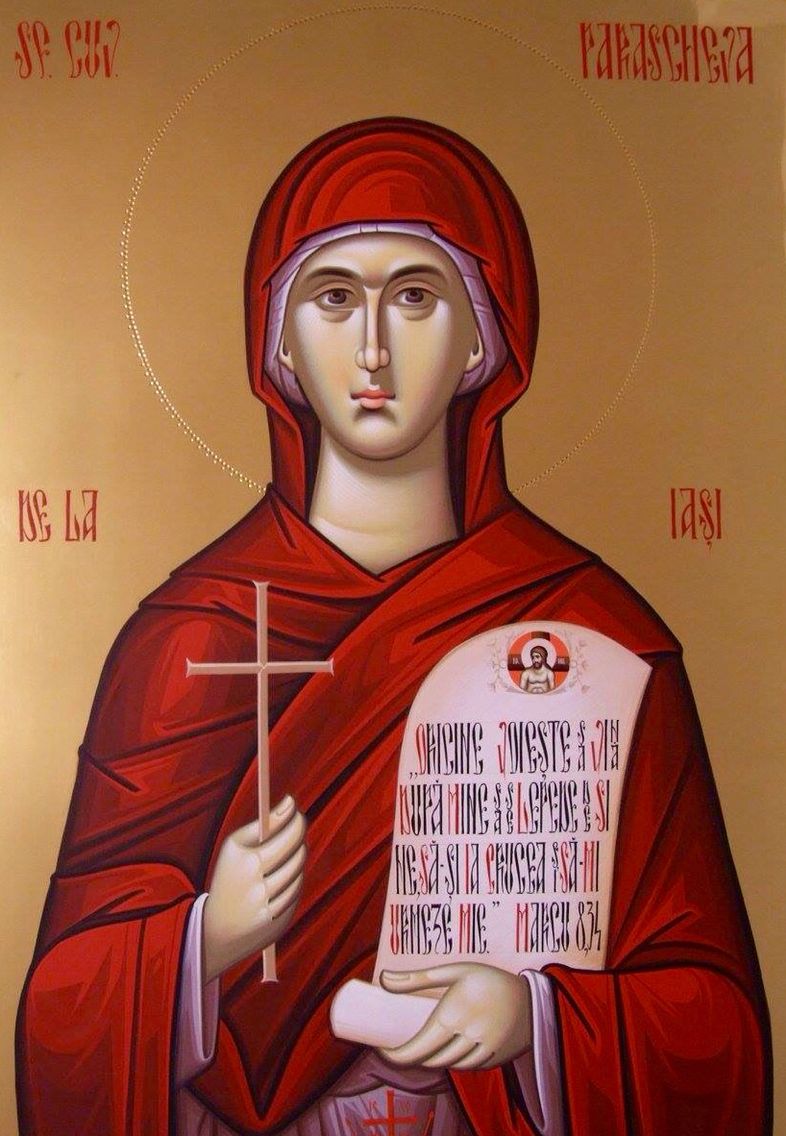
~+~
(27/14 October)
“You know that the rulers of the Gentiles lord it over them, and those who are great exercise authority over them; yet it shall not be so among you; but whoever wants to become great among you let him be your servant; and whoever desires to be first among you let him be your slave; just as the Son of Man did not come to be served, but to serve, and to give His life as a ransom for many.” (Matthew 20:25-28)
“Go, sell all that you have and give to the poor, and you will have treasure in heaven; and come, follow Me.” (Mark 10:21)
The truthfulness of these words of Christ was most vividly demonstrated by our Saint, the Venerable Paraskeva – Petka, who although small in stature and young in years, surpassed many men with her deeds, struggles and wisdom. To follow Christ, one does not need to be powerful, strong or famous, but most importantly, one must have a heart. By taking the last place and following Christ’s example of serving others, Saint Paraskeva – Petka achieved the goal to which we are called.
At the age of 15, she chose to live an ascetic monastic life and to be crowned as the bride of Christ. By the age of 25, she had managed to pass all three stages of spiritual perfection: purification of the heart, enlightenment of the mind, and the likeness of Christ or the deification of the person. At the age of 27, she already passed away, showing how much she loves her chosen one – Christ and that life on earth is worth nothing to her in order to acquire Him.
And so, fleeing to the extreme from earthly riches and honours, even being a stranger among her own people in her own city, she is today one of the most famous and revered Saints in the Orthodox Church. She is revered by Christians from all over the world and even by believers from different faiths. People line up in front of her shrine every day to pay their respects and pray to her for some kind of help, and there is literally no moment when she is alone, and people wait in endless lines to meet her.
It is said that the memory of saint Petka is brighter than the sun.
The portrait of the Venerable St. Petka is great and rich, and our mind is not capable to apprehend it as it should, and who can express her deeds and miracles, her goodness and intercession that she still performs among us Christians today.
Origin and Upbringing
This glorious and equal-to-the-angel saint, Saint Paraskeva – Petka, was born in 1025, in the city of Epivat (today Bojados) in Turkey, on the shores of the Sea of Marmara, near Constantinople, (today Istanbul). Her parents were rich and pious, and lived in everything according to the commandments of God. Her father was the governor of the city, and her mother, Sophia, was a wise Christian and pious noblewoman. As good and faithful people, they raised her in the fear of God, encouraging her to do good deeds. In addition to their daughter Paraskeva, they also had a son named Euthymius.
They raised their children in piety and taught them to live a virtuous and God-pleasing life. Raised in a virtuous Christian family with the fear of God instilled in her heart, blessed Paraskeva began her spiritual ascent on the ladder of virtues towards Christ from an early age, above all through holy prayer, which is the beginning of all goodness.
Virtuous Life
Saint Paraskeva was endowed with a multitude of virtues that adorned her soul and life. Especially these three virtues: angelic virginity, alms-giving and divine prayer, the mother of all good deeds. So she loved these virtues since her childhood, and through them, in a special way, she stripped herself of all earthly attachments and passions and, like a pure dove, soared into heaven to God.
From an early age she learned to pray a lot, day and night. To her prayers she added works of love and the struggle of fasting. Fasting gives wings to prayer and raises it to heaven, which is why she did not taste anything until evening, both, on fasting days and on celebration days. And through alms-giving, which is the “first daughter of love”, prayer is offered before the throne of the Most Holy Trinity. When she would have returned from Church, she often knew how to exchange her good and expensive clothes, given to her by her parents, for the poor and torn clothes of poor children who were begging for alms at the door of the Church.
For this, the pious Paraskeva received many admonitions and beatings from her mother, whenever she saw her dressed in ugly and poor clothing.
“Tell me, Paraskevo, who did you give your expensive and beautiful clothes that I dressed you in?” her mother asked angrily.
– I gave them to Christ through the hands of poor children! – she happily replied with a bright face.
Her parents, worried about her, rebuked her and strictly forbade her to do it again. But she continued to do it. When they scolded her for it, she firmly but at the same time calmly would have replied that she could not live any other way.
One day, Paraskeva, as a ten-year-old girl, while in Church with her mother, heard the words from the Holy Gospel: “Whoever wishes to come after Me, let him deny himself, take up his cross, and follow Me” (Mark 8:34). These words were deeply engraved in her youthful and pure heart full of love for Christ. She had heard these words before, but she was not ready then, and right now, the Lord wanted them to have an effect, as if struck in the heart by an arrow. She felt them so strongly and the grace of God filled her so much that from then on she decided to abandon the worries of earthly life and dedicate herself to the service of God. She secretly left her parental home at the age of only 15 and entered the arena of the holy struggle of monastic life.
Monastic Life
Burning with a desire to live only for the Lord, she could not remain long in this disturbing world and first went to Constantinople to worship at the holy places there. She worshiped at the Blachernae Church, as well as in all the monasteries and at the holy relics. Visiting all the shrines, she met many zealous ascetics and received much valuable advices from them. Following their advices, she settled in the suburbs of Heraklia, near the temple of the “Protection of the Most Holy Theotokos” and remained there for five years in fasting, prayer and tears.
Here the blessed Paraskeva, perfecting herself in all good works, and especially in unceasing prayer with many tears, with strict fasting and night vigils, began her spiritual ascent to perfection, uniting with the Bridegroom Christ. Filled with grace and mercy, she was soon loved by all the sisters in the monastery and they admired her life and wisdom. They glorified God, saying: “Glory to You, Lord, for the pious virgin Paraskeva, the chosen holy vessel. You are exalted among the meek and humble in heart!”
She surrendered herself to strict asceticism and, following the example of the Saints, through fasting, prayer, and vigil, she mortified the passions of her body and subordinated her body to the spirit, passing through all three stages of spiritual life: purification of the heart from passions, enlightenment of the mind, and becoming likeness of God or deification.
Her brother Euthymius, who had a desire for a more perfect spiritual life, also became a monk with the blessing of his parents. As a monk, he became famous for his ascetic life and was elected Bishop of Madita. As a Bishop, he became famous for his virtues and his fight against heretics. He died in old age and was buried in the cathedral church there. His venerable relics became a source of holy myrrh. Saint Euthymius performed many miracles, both during his earthly life and after his death.
In the Jordanian Desert
Fulfilling her long-standing desire, she travelled to Palestine and, after worshiping at the holy places sanctified by the life of the Savior, settled in the Jordan Desert. In the lifeless and harsh desert, she led a life like that of an angel. Following the example of the Prophet Elijah and Saint John the Baptist, she ate only desert plants, in small quantities, and only after sunset. She constantly raised her eyes only to the One God, Who saves the humble in heart from despondency and hardship.
Life in the Desert
Oh, who could express all the efforts, sufferings, torments and demonic temptations that Saint Petka endured during her many years of asceticism? Who can know how many tears she shed and how many sighs she sent up to God? Who could describe her daily battles that she waged with her body, her thoughts and her demons until she completely won?
Only God, Who is everywhere and Who sees everything, only He can see and know all her struggles. There she did not care about the vain things of this world, but only cared about the sanctification of her soul and the answer to the future Judgment and the meeting with the heavenly Bridegroom. Her main concern was how to decorate her lamp and go out with the wise virgins to meet the heavenly Bridegroom, to hear His melodious voice and to delight in the sight of His beauty.
She constantly kept in her mind the thought from the book “Song of Songs”: “Tell me, whom does my soul love?” (Song 1:7) also from the Psalms: “My soul thirsts for God, for the living God: when I come and see the face of God” (Ps. 42:3).
While the Venerable Paraskeva was leading such a life in the desert, the cunning enemy – the devil – envied her virtues and tried to frighten her with various fantasies and apparitions. Often, taking the form of various beasts, he attacked the holy ascetic in order to stop her on the path of asceticism. But she, despite her feminine youthful nature, acquired a masculine and elderly mind and defeated the devil, as David defeated Goliath. The good bride of Christ, Petka, “chose the Most High for her refuge” (Ps. 90:9) and with His help, with the sign of His holy cross, she drove out her enemies and tore apart all the nets of the devil and completely destroyed him.
Decorating her soul with such struggles and virtues, Paraskeva became the beloved bride of Christ, so that the prophetic word was fulfilled in her: “Even the king desires your beauty” (Ps. 44:12). Christ, with the Father and the Holy Spirit, dwelt in her, and she became a temple of the Living God.
Here for almost ten years she struggled with even more difficult troubles, defeating devils and praying for the world. Her good deeds with which she defeated the invisible and, being inexpressibly united with Christ, she achieved complete purity of mind and heart from passionate thoughts and fantasies. Unceasing prayer with tears, fasting, all-night vigils, and an inexpressible desire for the beloved Bridegroom, Christ, were the constant companions of the Venerable Petka. All this crowned Saint Petka with the crown of perfection in Christ, so that she shone like a burning torch among the other venerable nuns.
A Stranger Between Her Own People
When she turned 25, one night while she, according to her routine, stood in prayer and raised her hands to heaven with compassion, she saw an angel of God in the form of a very bright boy, who came to her and said: “Leave the desert and this place and return to Epivat, to your homeland, for there you must leave your body on earth and pass from this world to God, whom you love!”
The Venerable one delved into the meaning of that vision and when she understood that it was from God, she was filled with joy that she would soon be freed from the body, but at the same time she was saddened by the separation from the desert and solitude. Obeying the heavenly will of God, the Venerable Paraskeva departed for her native land. Thus, after Saint Paraskeva – Petka said goodbye to all the sisters in that monastery, she worshiped at the tomb of the Lord in Jerusalem and, taking a ship, arrived in Constantinople.
When she arrived in Constantinople, she went to the beautiful temple of God’s Wisdom, “Saint Sophia.” She stayed there for a short time and often knelt down, shed rivers of tears, and often sighed from her heart, and when she remembered her desert life, she was overcome with great sadness.
Then, like a diligent bee that flies around the spring flowers, she visited the holy places there and came to the temple dedicated to the Most Holy Mother of Christ – Blachernae. After bowing to the icon of the Mother of God, covered with tears, she prayed, saying: “To you, O Sovereign Lady, I have entrusted my whole life and in you I place all my hope; do not reject me, the wretched one. Do not despise your servant, who from her youth has followed your Only Begotten Son. Virgin, you know the weakness of female nature, you know the suffering of my soul; I have no other hope, I have no other protection; you are my teacher; you are my advocate, you are the guardian of my whole life. While I was walking in the desert, you were my helper; and now, when I have returned to the world, do I need no help except from you?! Therefore, now, O sovereign Lady, protect me and be my companion, teacher, and guide until the end of my life, for I have no other hope but you.”
After Saint Petka had thus prayed with all her soul, and placed all her hope in the Mother of God, she set out for her native land. When she arrived in Epivat, she lived there for another two full years in labour and suffering, as a stranger among her own people, adorning herself with constant fasting and prayer.
Blessed Repose and Burial
When she felt that her end is near, when the time had come to go to God, she knelt before the icon of the Savior and prayed with many tears for herself, for the Church, for the holy servants, for the hermits, for the sick, and for the entire world, and then in peace she surrendered her soul into the hands of the Lord.
“O Master, O Lover of mankind, do not despise Your poor servant, who for the sake of Your most holy name has left everything and followed You; and now, All-merciful Lord, command Your angel of peace to receive my wretched soul and not to be barred from its path to heaven by unclean and cunning demons, but grant me the right to stand freely before Your fearful throne, for You are blessed forever and ever. Amen!
Thus, in prayer, Saint Paraskeva surrendered her blessed soul into the hands of God, and her much-worn body was buried by the Christians in a new grave, close to the seashore, but not in the common cemetery, but separately, as a stranger, Who had not told anyone Who she was or where she was from. They buried her as a stranger, without anyone knowing who she was.
Behold, such were the struggles of the Venerable Petka, such were the fights of the spiritual mother who, although she had been an ascetic on earth for a short time, suffered much and received great glory in heaven. God did not allow her to remain unknown, nor for her immaculate body to decay, but even for this He performed a great miracle. Wishing to glorify His beloved, and for the comfort of the faithful, He revealed her holy relics after many years of her repose.
Miraculous Revelation of the Relics
Not far from the place where Saint Petka was buried, on a pillar, a certain ascetic was performing his asceticism. One day, the waves threw up the lifeless body of a sailor, who had fallen seriously ill during the voyage and died. An unbearable stench began to spread from his body, so that it was not even possible to pass that way. Even the ascetic on that pillar could not bear the smell, so he was forced to come down from the pillar and ask some people to dig a deep hole and bury the body. While digging, the people, by God’s providence, found the incorruptible body of the Saint and were greatly astonished. But, being simple and ignorant, they paid no attention to this miracle. “If this body is holy, God would reveal it through some miracle,” they thought. But even though they thought so, they buried the incorruptible body of the Venerable Saint Petka again, leaving it in the same place next to the half-decomposed, stinking corpse of the sailor, and went home.
The Empress Worthily Laid to Rest in Epivat
When it became dark, one of them named George, a man who loved Christ, prayed to God in his home, and when he fell asleep before dawn, he saw in a dream a queen sitting on a most radiant throne, and around her stood a multitude of most radiant soldiers.
When he saw this, George was seized with great fear and fell to the ground, unable to behold the splendour and beauty. And one of the bright soldiers took George by the hand, lifted him up, and sternly said to him: “George, why did you so defile the body of the Venerable Paraskeva and bury a decomposed body next to it?” Immediately remove the body of the Venerable one and lay it in a worthy place, for God desires to glorify His servant on earth.”
Then the bright empress addressed George and revealed herself to him: “Hurry up and take out my relics and lay them in a clean place, for I can no longer bear the stench of that corpse. For I too am a human and my homeland is Epivat, where you also now live.”
That same night, to make the revelation more convincing, a pious woman named Euthymia also had a similar vision. The next day, George and Euthymia told everyone about their visions. When the pious people heard this, they all rushed to the relics of the Venerable Paraskeva with candles, censers, and incense and they took them out of the ground with great awe, rejoicing in them as if they were some precious treasure.
When the clerics heard about this miracle, they immediately went to the tomb of the pious Paraskeva with candles and incense and took her holy relics to the Church of the Holy Apostles in Epivat, where they remained for 175 years and performed countless miracles and healings from diseases. Through the prayers of the Venerable Paraskeva, many people received healing from her holy relics: the blind received their sight, the lames started walking, and people suffering from various diseases were healed.
The Relics Protected in Tarnovo
But, after two centuries, the power of Byzantium began to weaken and, by God’s permission, the Latins occupied Constantinople in their fourth crusade. They stole many holy vessels, relics and other precious relics and valuables, and took them to Rome. The pious Bulgarian tsar Ivan Asen decided to protect the holy relics of the Venerable Paraskeva from the tyrannical rule of the crusaders and to shelter them in his kingdom.
At that time, he showed himself to be particularly brave in the battles with the crusaders and managed to subdue them and force them to pay tax to him. Tsar Ivan Asen was a very faithful and pious tsar who firmly adhered to Orthodoxy. Then he learned about the incorruptible relics of Saint Petka, and instead of a tax, he asked for them. When Emperor Asen conveyed to the crusaders his intention – to transfer the relics of Saint Petka to his capital, Tarnovo, they immediately agreed.
In 1238, the Bulgarian king Ivan Asen ordered the relics to be transferred to the capital city of Tarnovo. The holy relics of the Venerable one were solemnly welcomed by tsar Ivan Asen, his mother Elena, empress Anna, and the Veliko-Tarnovo’s Patriarch Joachim as well as by a huge number of people, solemnly gathered for the occasion. Afterwards, they were laid to rest in the court Church dedicated to the Venerable Paraskeva, where they rested incorruptibly and granted various healings to all who approached them with faith.
Later, when in 1393, Sultan Bayezid conquered the fortress of Tarnovo, the relics were taken to Vidin, where they remained for 5 years.
The Relics of Saint Petka Transferred to Kalemegdan in Belgrade
In 1396, Vidin also fell under Turkish rule. Then the relics were transferred to Serbia. More precisely, in 1398, at the request of the Serbian Empress Milica, the holy relics were transferred to Belgrade. After 160 years, after the relics of Saint Petka resided in Bulgaria, they were moved to neighbouring Serbia. For that occasion, a church dedicated to Saint Petka was built in Belgrade, which still exists today and contains the miraculous spring of Saint Petka.
Yet again, the relics did not remain here forever.
The invasion of the Turks and their infidel rule did not stop, and in 1521, sultan Suleiman II occupied Belgrade and seized great wealth. Among other things, he seized the relics of Saint Petka and they were returned to the Patriarchate of Constantinople.
First, the sultan placed them in his palace and there, in this pagan place, numerous miracles occurred from the divinely-powerful holy relics, which is why the Venerable Paraskeva was celebrated and respected not only by Christians, but also by muslims. But this disturbed the hardened muslims, and they, fearing that the belief in the miraculous power of the holy relics of Saint Petka would spread even further among muslims, and also because of the pleas and the intercession of the Christians, handed over the holy relics to the Christians of Constantinople, and they honourably placed them in the Patriarchal Church.
About 120 years later, the financial situation of the Patriarchate seriously deteriorated and it was unable to pay the full tax to the sultan, so sultan Suleiman the Magnificent asked the Patriarch to buy back the relics of Saint Paraskeva, telling him that if he did not buy them, he would throw them into the sea. Thus, the relics were purchased for 12,000 ducats, thanks to the Moldavian Prince Duke Basil (Vasiliy Lupu).
Finally, The Relics of Saint Petka in Moldova, Romania
In 1639, the ruler of Moldavia, Vasile Lupu, completed the construction of the beautiful church of the monastery of the Holy Three Hierarchs, in Lași. Vasile himself had great respect for this Saint and wanted with all his heart that the relics of Saint Petka be transferred to this holy temple in his Orthodox country. This desire of his was blessed by the Lord, who wanted to glorify His Saint in Moldova as well, and so He placed in the heart of the Patriarch of Constantinople, Parthenius, the thought of fulfilling the wish of the Moldavian duke.
Then the Patriarch, in agreement with the entire holy council, sent the Venerable relics of Saint Petka to duke Basil in his capital city of Lasi, where they rest to this day, deeply revered by the entire Romanian people.
To make his wish more certain and to have it approved, he also offered financial assistance to the Patriarchate of Constantinople. Finding himself in a financial crisis, the offer of this merciful Moldavian ruler was readily accepted, who paid off a large part of the Patriarchate’s debts to the Turks. Thus, in the summer of 1641, Patriarch Parthenius, as a sign of gratitude, presented him with the most precious blagomiris/delightful-incense he had – the relics of the Venerable Paraskeva. They were brought to Galati by ship, and from there to Lași they were accompanied by numerous priests, monks and believers with lit torches in their hands.
The inhabitants of all of Moldova welcomed the Venerable relics of this great Saint with great celebration and joy, and they were laid in the temple dedicated to the “Holy Three Hierarchs”, on October 14 (or October 27, according to the new style) in 1641. Countless are the miracles and healings from diseases that happened to the believers, who with prayers and tears ran to the relics of Saint Petka in Lasi.
Holy Relics Untouched by the Great Fire
In 1884, reconstructions began in the monastery’s church and the holy relics were transferred to the monastery’s chapel. They were placed on a wooden catafalque.
On the evening of December 26, 1888, after the evening service, the candle from the candlestick to the reliquary with the relics of the Venerable was forgotten unextinguished. During the night, the candlestick burned down, and then the fire spread to the catafalque on which the relics were located. Smouldering all night, the flames turned the coffin into a pile of coals.
The next morning, state and church authorities, priests and believers discovered that the holy relics had remained intact. The fire had melted some of the silver fittings on the coffin, but by a divine miracle the relics remained intact. Not a trace of fire or heat had penetrated inside. Only the pillow under the Saint’s head was slightly smoked. Thus, weeping with joy and glory to God and giving thanks to the pious Paraskeva, they all fell to their knees and recited an Akathist prayer to the Saint.
Raised from the pile of embers, the relics were temporarily placed in the altar of the chapel in the monastery of the Holy Three Hierarchs. A very good and faithful Christian, Lupu Botez, with the help of other believers, built a new coffin of cypress wood, dressed with silver fittings. Placed in the new coffin, the relics of the Venerable one were taken with special honours, led by the Metropolitan himself together with the priests, to the new Metropolitan cathedral dedicated to the “Presentation of the Lord” in Lasi, which had been consecrated shortly before, on April 23, 1887, where they still rest today. And the wooden coffin, burned only on the outside, is kept in the neighbouring church, as a testimony to the miracle.
Miracles and Healings
There are countless miracles from the intercession of this Saint that still happen today. Many are known from the stories of those who heard them, but even more remain a mystery to those who experienced them. It is enough for Saint Paraskeva to heal or comfort you once and every year to go to her relics, with much faith in your soul. For such people, the road seems shorter, life’s hardships become easier, and the return home is made with more joy and strength.
Above all, the greatest miracle of Saint Paraskeva is the preservation of her body with the gift of incorruptibility, of healing diseases and deliverance from many needs and dangers. For this reason, Saint Petka is one of the most revered Saints of Christ and is considered a protector in all orthodox countries in the Balkans. Even the Turks were impressed by the miracles performed on Christians who sought help with faith and piety.
Let us mention just a few (new) miracles that have occurred through the prayerful intercession of this Saint.
~ + ~
At the end of the 19th century, the wife of the priest Gheorghe Lates, from the municipality of Radaseni – Suceava, suffered from a severe and incurable head disease. He came to Saint Paraskeva and prayed with tears to the relics of the Saint and asked her for help. At night, the Saint appeared to him in shining white clothes and said to him: Stop crying, because from now on your wife will be healthy! The next day the woman woke up healthy and praised her benefactor.
~ + ~
During World War II, the Saint protected the city of Iasi from destruction by appearing in the middle of the front between the warring sides as a very tall woman standing upright. At those moments, the soldiers felt weak and unable to fight. Thus, taking away their strength, she protected her city.
~ + ~
In 1950, a young woman from Iași fell ill with leukemia. Filled with faith and hope, she and her parents ran to Saint Paraskeva and with many tears asked her for help and health. After two months of persistent prayers and holy anointing, the young woman was cured of this incurable disease and continued her studies.
~ + ~
A woman from a village near Iași was seriously ill with stomach pain. Since she was hospitalized for surgery, she first prayed to Saint Paraskeva, asking her with faith and tears for help and healing. Three days after hospitalization, all the tests were done and the results showed no signs of illness. The doctors told her: “Woman, go home because you have nothing!”
~ + ~
An engineer with a lung disease was hospitalized in Iasi for surgery. His mother went to the relics of the pious Paraskeva and faithfully asked her for her son’s health. For two weeks, the doctors postponed the operation. Afterwards, it was noted that the pulmonary condition had miraculously healed. The doctors were amazed and told him: “Mr. Engineer, you escaped the operation, return home safely. There is someone praying to God for you!”
~ + ~
A three and a half year old child suddenly stopped speaking. Then the mother took the child in her arms and came to ask for help from Saint Paraskeva. While she was praying with tears, the child suddenly cried out: “Mom, Mom! Here is my God?” Thanking the blessed Paraskeva from the bottom of her heart, the mother returned home with the healthy child.
~ + ~
In 1955, two spouses from Iași had a major disagreement at home. One evening, the desperate woman left home. Her husband and daughter searched for her in vain. Then the child went to sleep, and her father ran to Saint Paraskeva and prayed with tears to bring his wife back safely. When the husband arrived home, an hour later someone knocked on the door. It was his wife! Her face was pale and thoughtful.
– “Where have you been, woman? What happened to you?” her husband asked.
– The devil made me think of committing suicide. So I sat on the railway line, near the Nikolina station. But at 8 o’clock in the evening, when the fast train was coming, our daughter dressed in white came to me, quickly grabbed me and threw me off the line. Thus I escaped death and the damnation of hell! After I became a little stronger, I thanked God for saving me from this terrible sin and returned home.
– Woman, tonight at 8 o’clock, our daughter was sleeping, and I prayed to the blessed Paraskeva for you. The one who saved you was not our daughter, but Saint Paraskeva herself! Let us thank her, because she saved you from this terrible and double death, physical and spiritual.
Since then, much harmony and spiritual joy have reigned in this Christian family.
~ + ~
Thanks to the patroness of the city of Iasi, during the second world war, it was protected from bombing, and the Metropolitan cathedral, where the holy relics of Saint Paraskeva are kept, was not touched by a single shrapnel because she has been protecting Moldova and this blessed city for 350 years. Elders say that soldiers at night, during the war, saw a huge woman dressed in white over Iasi, protecting it from occupation and bombing.
~ + ~
During the great drought of the summer of 1947, when people and animals were dying of hunger, the relics of Saint Paraskeva were taken in procession through the villages of Moldova. The faithful awaited them and greeted them with tears of joy and torches in their hands. After her prayers, clouds of abundant rain appeared and watered the land.
~ + ~
Believers from all professions, of different social status and ages prayed to the Saint for their needs. Especially during the exam months, her shrine was filled with books, school notebooks and notebooks from students and pupils.
~ + ~
On October 14, 1952, an unusual miracle occurred. Among the people waiting for their turn to bow before the reliquary of the Venerable Paraskeva were two elderly Christians from Focsani. Seeing the large crowd, they said to the priest on duty, Archimandrite Cleopas Ilie:
• Father, give us permission to bow to the Venerable Paraskeva, without standing in line, because we are sick, and to place this pillow under her head, which we brought from home as gratitude for the help she gave us.
• May God bless you, said Father Cleopas. Go and bow down!
At that moment the priests and the faithful saw something very sweet and wonderful. The Venerable one raised her head herself, and after the women placed the pillow they had brought her and bowed down, she again bowed her head down as before.
~ + ~
Even today, miracles still happen through the prayers of Saint Petka. As is the case with Domnika Ivan, who could not move. She was treated by 4 neurosurgeons, and everyone told her that if she did not have surgery, she would remain paralysed. She now says about herself: “With prayer and faith, I stand and I do not have surgery.”
~ + ~
Likewise, pilgrim Ciro Stefan, who, thanks to the prayers of Saint Petka, can now move his hand and work with it freely without surgery.
This is how much the All-Merciful God loves those who pray to God and His Saints with humility and faith! Saint Paraskeva of Iasi enjoys a special cult in the country, more than all other local Saints whose relics are in Romania.
Ceremonial Change of Clothes
It is notable that the pious Saint Paraskeva wears bright vestments during feast days and dark colours during Lent. This is because the priests change the Saint several times a year.
The pious Paraskeva’s vestments are changed on Christmas Day, at the beginning of Lent when she receives a dark-coloured vestment, the day before Easter she dresses in a white vestment, in which she is kept until after Pentecost, the evening before she is taken out of the Cathedral for the Procession along the “Path of the Holies”, and after the feast.
When the holy relics of Saint Paraskeva are changed, the cathedral is closed. The priests untie the clasps that fasten the vestment from behind, and the holy relics remain wrapped in a second vestment that is never changed. It is said that this is the vestment in which the holy relics were brought and is like a kind of seal.
This shroud is made of linen cloth, worn out over the years, and on which is inscribed like a seal the curse of Vasile Lupu and metropolitan Varlaam: “Cursed be he who will ever scatter the relics of the Holy Pious Paraskeva.” The new vestment that is wrapped around the body of the Venerable Paraskeva is fastened with clips at the back in certain places. The crown in the area of the Saint’s head fixes the garment like a veil. After the pillows that are in the reliquary are also changed – the pillow from the head of the Saint and the pillow from the feet, the pious Paraskeva is placed in the reliquary.
Pilgrimage and Solemn Procession
Every day, in the metropolitan cathedral of Iasi, from morning until late at night, there is a continuous pilgrimage. Believers of all ages, social statuses and from all parts of the country and abroad come to pray to the Saint. There is simply no time when there is not someone in front of the ark of the Venerable one, and even queues waiting to pay homage. Especially on feast days, during Lent, and every Friday, which is considered “Holy Friday,” that is, on the day of the pious Paraskeva1, hundreds of thousands of believers come and worship the relic with faith, they bring flowers, gifts and clothing that they touch to the pious reliquary to receive help, health, and blessings and not only Orthodox, but also non-Orthodox people like a muslim named Mustafa.
“I am a muslim, I have not converted.” I came here with my muslim identity, but that did not stop me from feeling divine grace. I feel so good here, I feel healthy. It is fortunate that we have the relics of the Saint here in Iasi.”
But the biggest day of celebration during the year is October 14, the day of the Patron Saint of Saint Paraskeva, when one of the largest Orthodox pilgrimages in Romania and the Orthodox Church takes place. The event is attended by believers from villages and cities, from all corners of the country and beyond. This day is considered a true national church holiday that lasts up to 3 days and occurs every year, the holy relics are taken out of the Church into the front yard and placed on a special podium decorated with flowers, to facilitate the thousands and thousands of people who come to venerate them.
From the eve of the feast, the relics of Saint Paraskeva are brought out in front of the cathedral and for two days and two nights, believers stand in line for divine-service. On the evening of October 14, the Saint’s feast day ends with a procession around the cathedral, led by the Metropolitan of Moldova, who, together with the clergy and the faithful, carrying candles in their hands, carries the ark with the relics of the Saint along the “Path of the Holies”, celebrated by the sound of bells and beautiful church singers. After that, the relics are placed in their place in the Church, the Akathist to Saint Paraskeva is sung, and everyone returns to their own places with the joy of the great feast day with the comfort of the Holy Spirit in their hearts.
In recent years, a tradition has been established that on this day, in addition to the relics of saint Petka, other relics from other orthodox countries are brought for the veneration of the faithful.
Three Major Processions Across the Provinces of Romania
The holy relics have only been taken out of the city of Iași three times on special occasions. During major crises such as drought, disease, war or some kind of disaster.
The relics of the Venerable Paraskeva left Iasi for the first time in 1944. The Soviet offensive envisaged the occupation of part of Moldova, and in order not to fall prey to ill-wishers, on March 15, 1944, they were taken to Bucharest under military escort to the Ciorogarla Monastery near Bucharest. Between October 27 and November 26, 1944, the relics were placed next to those of Saint Demetrius Basarabov in the Bucharest cathedral and returned to the metropolitan cathedral of Iași on November 26, 1944.
The second time was in 1947 during a great drought. In the summer of 1947, the relics of Saint Paraskeva were taken in procession through the villages of Moldova. The faithful awaited them and greeted them with tears of joy and torches in their hands, praying for clouds of abundant rain to appear to water the land.
That summer, Romania was hit by a severe drought, many people and animals were starving, and the rest could barely survive. For this reason, the relics of Saint Paraskeva were taken out of the cathedral and carried in procession through the villages of Moldova. In a long religious procession, she was first taken to some places in the Iași county area, in May and June, then from one end of Moldova to the other, in July and August, in the hope that the Saint would put an end to the most terrible drought in the country. Throughout the procession, the faithful waited for and greeted the holy relics with tears of joy and torches in their hands. Miraculously, due to the prayers of the faithful and the intercession of the Saint, large rain clouds descended and Romania was saved from the great crisis.
And the third time the holy relics were brought out now, during the pandemic in 2021, in the 7-day period before the feast of Saint Paraskeva.
The Communist Government Remained Powerless Before the Power of the Venerable
There was a danger during the communist period that they would be destroyed. During the years 1950-1954, the number of pilgrims coming to the relics of the pious Paraskeva increased. The communists decided to secretly bury her body. The morning when those delegated for this task began digging a pit in a nearby cemetery, the sky suddenly darkened, a strong wind began to blow, and the area was hit by torrential rain with hail, thunder and lightning. Frightened, the people ran to the Cathedral to seek help from the Venerable and God’s mercy. After the ringing of the bells, the faithful performed the Akathist and the Saint’s prayer, as well as other prayers to the Mother of God. Immediately after these prayers, the storm subsided and the sky brightened.
Three Saints with the Same Name
Saint Paraskeva (Petka) is a particularly beloved and revered Saint in the Orthodox Church. However, it is important to make a distinction and know that the Orthodox Church celebrates three different Saints with the same name, Paraskeva or Petka. All three lived at different times and in different places and were celebrated in different ways, and therefore it is necessary not to confuse them and to distinguish them.
The first Saint with this name is the Venerable Martyr Paraskeva of Rome (July 26/August 8). She lived in the 2nd century and preached about Christ to the pagans in an apostolic manner and converted many to the true faith. She was very beautiful and many sought her as a wife, but she decided to live a virgin life for Christ. She was tortured many times, but God protected her. After her prayers, Emperor Adrian regained his sight. In the end, she was beheaded with a sword after cruel and prolonged torture during the time of the roman emperor Therasius. Saint Paraskeva, with her courage and miracles, led many to faith. Her relics were later transferred to Constantinople. On icons, she is depicted with a cross in one hand and a tray of eyes in the other.
The other is the great martyr Paraskeva of Iconium (October 28 / November 10). A native of Iconium (Asia Minor) in the 3rd century, she dedicated her life to charity and good works. Because of her faith in Christ, she was brought to trial and when asked her name, she said that her name was Christian. “First I should have told you the name of my eternal life, and then of my temporal life,” she replied to the emperor. During her torture, an angel of the Lord appeared to her, who healed her wounds and comforted her. After prolonged torture, she was beheaded with a sword during the reign of the persecutor Diocletian in 303. She is depicted with a cross in one hand and a scroll in the other, and in many of her icons she wears a white veil on her head.
And the third is our Saint, Venerable Paraskeva (Petka) of Epivat. She lived in the 10th-11th centuries (celebrated on October 14/27). She was a native of Epivat and was a nun. Her relics are completely preserved and are today in the city of Iasi in Romania. She is depicted only with a cross in her right hand.
With numerous miracles, even to this day, these holy relics unceasingly glorify the Lord, Who is glorified in His saints.
Through the prayers of Saint Paraskeva – Petka, Lord Jesus Christ, have mercy on us!
Prepared by Father Gabriel (Galev)
Abbot of the Monastery “St. Clement of Ohrid”,
Kinglake, Melbourne, Australia
______________________
1 The name Paraskeva comes from the day Friday in Greek. She was born on a Friday and that is why her parents named her after the day.
